Best AI Email Marketing Tools 2026 (Workflow-First)
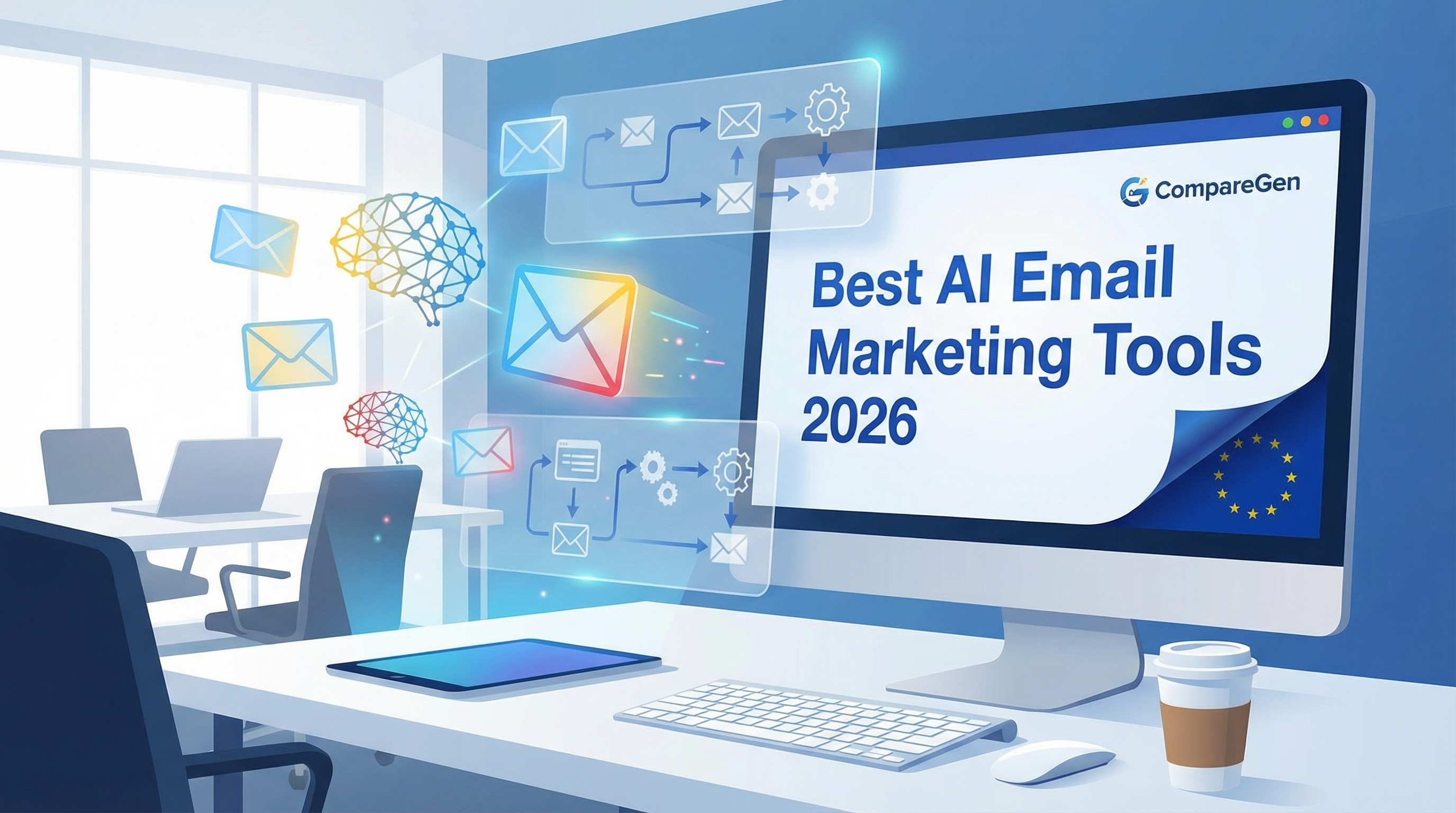
Best AI Email Marketing Tools 2026 (Workflow-First)
Most "best email marketing tools" listicles rank by feature count or brand recognition. That's not useful.
If you send email professionally — whether you're a solo founder dripping a welcome sequence, a DTC brand running weekly promos, or an enterprise marketing team orchestrating lifecycle campaigns across segments — the real question is how AI changes your daily workflow:
- Can the AI write a first draft you'd actually send, or does it just create more editing work?
- Does personalization go beyond "Hi " — adapting content, timing, and offers per recipient?
- Do automations set themselves up, or do you still drag boxes for a week before anything sends?
- Does the tool surface actionable insights, or just dashboards you'll never check?
This guide compares seven AI-powered email marketing platforms across the dimensions that matter for daily operations:
- Best for who
- AI content generation quality
- Personalization & segmentation
- Automation & workflows
- Deliverability & analytics
- Pricing
If you're evaluating adjacent tools, you might also want:
- Best AI marketing tools 2026
- Best AI lead generation tools 2026
- Best AI writing tools 2026
- Best AI chatbot builders 2026
- Best AI customer support tools 2026
- AI email campaign generator shortlist
- Best AI email subject line generator
Affiliate Disclosure: This post contains affiliate links. We may earn a commission if you make a purchase through our links, at no extra cost to you. This helps support our work.
Quick picks (if you just need a starting point)
- Best for interactive, AMP-powered emails without coding: Mailmodo
- Best all-in-one for SMBs on a budget: Brevo (formerly Sendinblue)
- Best for ecommerce revenue attribution and predictive AI: Klaviyo
- Best for small ecommerce stores wanting simplicity: Omnisend
- Best for send-time optimization at enterprise scale: Seventh Sense
- Best for enterprise-grade AI copy and brand voice: Phrasee
- Best AI writing assistant for email content teams: Jasper
If your job is narrower than choosing a full ESP or lifecycle stack, jump straight to our AI email campaign generator shortlist when the immediate job is building the whole send faster, or use the AI email subject line generator shortlist when the bottleneck is testing hooks and open-rate lift.
When you already have two or three subject-line or lifecycle tools on the table, use Compare Tools next so you can pressure-test finalists without losing the workflow context from this roundup.
How we evaluated these platforms
We used a workflow-first scoring lens:
- AI content generation: How useful the AI is for drafting subject lines, body copy, and visual emails
- Personalization & segmentation: Depth of AI-driven personalization — behavioral, predictive, and content-level
- Automation & workflows: How much the AI reduces manual workflow setup and ongoing maintenance
- Deliverability & analytics: Inbox placement, reporting depth, and whether insights lead to action
- Pricing clarity: Whether cost scales predictably as your list and send volume grow
- Best for who: Business type, team size, and email maturity
No tool wins everywhere. The right pick depends on what bottleneck you hit most: writing, personalization, automation complexity, or deliverability.
1) Mailmodo
Best for who
Marketing teams that want higher engagement through interactive, AMP-powered emails — forms, surveys, carts, and booking widgets right inside the inbox. Particularly strong for product-led growth teams running in-email experiences without redirecting to landing pages.
AI content generation
Mailmodo's AI generates subject lines, preheader text, and email body copy from prompts. It also suggests layout variations for AMP emails. The copy quality is serviceable for transactional and promotional emails but benefits from editing for brand voice. Where it stands out: the AI can generate interactive email elements (polls, NPS surveys, quizzes) alongside copy, reducing the creation-to-send cycle significantly.
Personalization & segmentation
Behavioral segmentation based on email interactions, website activity, and custom events. AI-powered send-time optimization adjusts delivery per recipient. Dynamic content blocks personalize offers and CTAs by segment. The AMP interactivity layer adds an implicit personalization dimension — responses collected inside emails feed back into segmentation.
Automation & workflows
Visual workflow builder with pre-built templates for common sequences (welcome, abandoned cart, re-engagement). AI suggests workflow improvements based on drop-off analysis. The standout feature is AMP-native automations — trigger follow-ups based on in-email actions (form submitted, poll answered) without needing a separate landing page analytics pipeline.
Deliverability & analytics
Solid deliverability infrastructure with dedicated IP options and domain authentication guidance. Analytics track both traditional email metrics and AMP interaction metrics (form completions, in-email clicks). A/B testing for subject lines, content, and send times. The in-email engagement data gives you a richer picture than open/click rates alone.
Pricing
Free plan available (limited sends). Paid plans start around $39/month for 2,500 contacts. Scales by contact count. AMP features are included on all paid plans — not gated behind enterprise tiers, which is a plus. Higher plans unlock advanced segmentation and priority support.
Bottom line
Choose Mailmodo when interactive email experiences are your differentiator. If you're still sending static HTML emails and want to stand out in the inbox, this is the tool that makes AMP emails practical without a dev team.
2) Brevo (formerly Sendinblue)
Best for who
Small and mid-size businesses that need email, SMS, chat, and CRM in one affordable platform. Brevo is the Swiss Army knife of marketing tools — it does a lot, does it reasonably well, and doesn't charge enterprise prices.
AI content generation
Brevo's AI Assistant generates email subject lines, body copy, and campaign ideas from brief prompts. It drafts full email templates and suggests A/B test variants. Quality is good for straightforward promotional and transactional emails. It won't replace a senior copywriter for nuanced brand storytelling, but it reliably produces clean first drafts that need minimal editing for SMB use cases.
Personalization & segmentation
Contact segmentation based on behavior, demographics, purchase history, and engagement scores. AI-driven product recommendations for ecommerce. Dynamic content blocks adapt email sections per segment. Predictive send-time optimization is available on higher plans. The CRM integration means segmentation data flows naturally from sales and support interactions.
Automation & workflows
Drag-and-drop workflow builder with a solid library of pre-built automations. AI suggests workflow templates based on your business type and goals. Multi-channel automations span email, SMS, and WhatsApp from a single builder. The automation logic is capable enough for most SMB needs — conditions, splits, delays, and multi-step sequences all work intuitively.
Deliverability & analytics
Strong deliverability with dedicated IP options, DKIM/DMARC guidance, and real-time blacklist monitoring. Reporting covers opens, clicks, conversions, revenue attribution (for ecommerce), and heat maps. The analytics aren't as deep as enterprise platforms, but they're actionable for teams that want insights without a data analyst.
Pricing
Free plan available (300 emails/day, unlimited contacts). Paid plans start at $9/month based on email volume, not contact count — a meaningful difference for businesses with large lists and moderate send frequency. Business plan (from $18/month) adds marketing automation, A/B testing, and advanced stats.
Bottom line
Pick Brevo when you need a cost-effective all-in-one that covers email, SMS, and basic CRM without juggling three subscriptions. It's not the best at any single thing, but it's good enough across the board and the pricing model is genuinely SMB-friendly.
3) Klaviyo
Best for who
Ecommerce brands — from Shopify stores doing $500K/year to enterprise DTC brands. Klaviyo is purpose-built for ecommerce email and SMS, with AI that directly ties to revenue attribution. If you sell products online, this is the default choice to evaluate.
AI content generation
Klaviyo's AI generates subject lines, email body text, SMS messages, and review request copy. The Subject Line AI is trained on ecommerce-specific data, which shows — suggestions are conversion-oriented and less generic than general-purpose AI tools. Campaign creation includes AI-powered content suggestions based on product catalog data and customer purchase history.
Personalization & segmentation
This is Klaviyo's core strength. Predictive analytics model expected next order date, customer lifetime value, churn risk, and spending tier. Segments update in real time based on behavioral data from your store. AI-driven product recommendations are built in and personalized per customer based on browse and purchase history. Dynamic content blocks adapt offers, product grids, and urgency messaging per segment.
Automation & workflows
Pre-built flows for every ecommerce lifecycle moment: welcome series, abandoned cart, post-purchase, win-back, browse abandonment, price drop alerts, back-in-stock notifications. AI suggests flow optimizations based on performance data — recommending split tests, timing adjustments, and content changes. The flow builder is powerful and ecommerce-aware, understanding concepts like order value thresholds and product categories natively.
Deliverability & analytics
Excellent deliverability infrastructure with smart sending (throttling to protect sender reputation), bounce management, and engagement-based list hygiene. Revenue attribution is best-in-class — you see exactly how much revenue each email, flow, and campaign generated. A/B testing with statistical significance indicators. Benchmarking against industry peers.
Pricing
Free plan up to 250 contacts and 500 email sends. Paid plans start at $20/month for 251–500 contacts and scale based on contact count. Gets expensive at scale (10K contacts runs ~$150/month, 50K contacts ~$720/month). The cost is justified if you're actively using the predictive features and seeing revenue attribution, less so if you're just sending newsletters.
Bottom line
Choose Klaviyo when ecommerce revenue per email is your north star metric. The AI is tuned for selling, the segmentation is built on purchase data, and the analytics tie directly to your bottom line. Expensive at scale, but it earns its cost if you use it fully.
4) Omnisend
Best for who
Small to mid-size ecommerce stores (especially Shopify and WooCommerce) that want ecommerce-focused email and SMS without Klaviyo's complexity or price tag. Omnisend is the practical alternative for brands that want automation that works out of the box.
AI content generation
AI-powered subject line generation and content suggestions. The AI Product Picker automatically pulls products from your store into email templates based on customer behavior or manual selection. Copy generation is functional — it produces clean promotional emails — but less sophisticated than Klaviyo's ecommerce-trained models. The real time-saver is the AI-assisted email builder that generates complete campaign layouts from a brief.
Personalization & segmentation
Behavioral segmentation based on purchase history, browse activity, email engagement, and lifecycle stage. Pre-built segments for high-value customers, at-risk buyers, and new subscribers. Product recommendations adapt per customer. Conditional content blocks personalize emails by segment. Not as deep as Klaviyo's predictive models, but covers the segmentation use cases that drive 80% of revenue for most small ecommerce stores.
Automation & workflows
This is where Omnisend shines for its target audience. Pre-built automation workflows are genuinely ready to activate — not templates that need heavy customization. Welcome series, abandoned cart, order confirmation, shipping updates, cross-sell, win-back, and browse abandonment all come pre-configured with best-practice timing and content. Automation splits let you A/B test within flows.
Deliverability & analytics
Good deliverability with automatic list cleaning, engagement-based sending, and authentication tools. Campaign and automation reports include revenue attribution, click maps, and device breakdowns. Sales dashboards show email and SMS revenue side by side. Less granular than Klaviyo's analytics but practical and clear.
Pricing
Free plan for up to 250 contacts (500 emails/month, basic features). Standard plan from $16/month for 500 contacts. Pro plan from $59/month adds advanced reporting, SMS credits, and priority support. Pricing scales by contacts — more affordable than Klaviyo at most tiers (roughly 30–40% less at equivalent list sizes).
Bottom line
Pick Omnisend when you want ecommerce email automation that works immediately without spending weeks configuring flows. It's the 80/20 play — you get most of what Klaviyo offers at a lower price and with less setup complexity.
5) Seventh Sense
Best for who
Enterprise marketing teams using HubSpot or Marketo that want AI to optimize email send times and engagement frequency at the individual recipient level. Seventh Sense isn't a full email platform — it's an optimization layer that makes your existing platform perform better.
AI content generation
Seventh Sense doesn't generate email content. Its AI focuses entirely on the when and how often of email delivery. This is a deliberate scope choice — it integrates with your existing email platform's content tools and adds the intelligence layer that those platforms lack.
Personalization & segmentation
Send-time personalization is the core feature. The AI builds an engagement profile for each contact based on historical open and click behavior, then delivers emails at the optimal time for each individual — not a best-time-for-the-list average, but a unique time per person. It also models optimal email frequency per contact to prevent over-sending and fatigue.
Automation & workflows
Integrates directly into HubSpot and Marketo workflows. Once connected, your existing automations gain individual send-time optimization without changing the workflow structure. Throttled sending distributes emails over a time window to improve deliverability and give sales teams time to follow up on engagement. AI-optimized frequency caps prevent contacts from receiving too many emails across campaigns.
Deliverability & analytics
This is where Seventh Sense earns its price. By distributing sends and optimizing timing per recipient, it materially improves open rates and reduces spam complaints. Analytics show engagement lift per campaign, optimal send windows, and contact fatigue scores. The deliverability improvement from distributed sending is particularly valuable for teams with large lists (100K+ contacts).
Pricing
Starts at $450/month for HubSpot integration (includes 5,000 contacts). Marketo integration starts at $360/month. Scales by contact volume. Not cheap — this is an enterprise add-on, not an SMB tool. The ROI case is strongest for teams sending to large lists where a 10–20% open rate improvement translates to meaningful revenue.
Bottom line
Choose Seventh Sense when send-time optimization is the highest-leverage improvement you can make. If your content and segmentation are already solid but engagement rates have plateaued, this is the tool that moves the needle — without changing anything else in your stack.
6) Phrasee
Best for who
Enterprise brands and large retail/ecommerce companies that need AI-generated marketing language at scale — and need it on-brand. Phrasee focuses on generating and optimizing the words that drive opens and clicks: subject lines, push notifications, SMS, social ads, and email body copy.
AI content generation
This is Phrasee's entire purpose, and it's best-in-class for enterprise email copy. The AI generates subject lines, email body copy, CTAs, and promotional language trained on your brand's voice, tone, and compliance requirements. It doesn't just generate — it optimizes. Phrasee runs multivariate experiments across language variants and automatically promotes winners. The brand voice model learns over time, so output quality improves the longer you use it.
Personalization & segmentation
Phrasee personalizes at the language level rather than the data level. Different customer segments receive different messaging variants optimized for that segment's response patterns. The AI learns which language styles resonate with which audiences — urgency-driven vs. benefit-led vs. curiosity-based — and adapts accordingly. This complements your ESP's data-driven personalization with language-level personalization.
Automation & workflows
Integrates with major ESPs (Salesforce Marketing Cloud, Adobe Campaign, Braze, Iterable, and others). Once connected, Phrasee generates and tests language variants within your existing campaign and automation workflows. The "set and optimize" model means campaigns automatically shift toward best-performing variants without manual intervention.
Deliverability & analytics
Phrasee doesn't manage deliverability directly (that's your ESP's job), but it indirectly improves it by increasing engagement rates — higher opens and clicks signal sender reputation positively. Analytics are language-performance focused: which words, phrases, and emotional tones drive the best results for your audience. ROI reporting ties language optimization to revenue lift.
Pricing
Enterprise pricing — custom quotes based on send volume and channels. Expect $1,000+/month minimum. Phrasee targets teams sending millions of emails monthly where small percentage improvements in open and click rates translate to significant revenue. Not appropriate for SMBs or early-stage companies.
Bottom line
Choose Phrasee when language optimization is the performance lever and you're operating at enterprise scale. If you're sending millions of emails and a 2% open rate improvement means six figures of additional revenue, Phrasee's AI copywriting and testing engine is built exactly for that.
7) Jasper (for Email)
Best for who
Content marketing teams that produce email campaigns alongside blog posts, social content, and ad copy — and want a single AI writing assistant across all channels. Jasper isn't an email platform; it's an AI content tool with strong email templates and workflows that feed into your existing ESP.
AI content generation
Jasper's strength is versatile, high-quality AI writing. For email specifically: campaign briefs, subject line variants, body copy, promotional sequences, newsletter content, and re-engagement messages. The Brand Voice feature trains the AI on your style guide, past emails, and tone preferences. Output quality is among the best for marketing copy — it understands hooks, urgency, benefit-first structure, and CTA optimization. Templates cover specific email types: product launch, sale announcement, welcome series, cart abandonment, and more.
Personalization & segmentation
Jasper doesn't handle segmentation or send logic (that's your ESP's job). However, it generates personalized content variants per segment — you can produce five versions of the same campaign tailored to different audiences in minutes. The Brand Voice + audience context combination produces more relevant copy than generic AI, though the personalization is at the creation level, not the delivery level.
Automation & workflows
Jasper's workflow features focus on content creation, not email automation. Campaign Briefs let you define a campaign's goals, audience, and key messages, then generate all assets (emails, landing pages, ads) from that brief. Collaboration features support team drafting, review, and approval. For email automation (triggers, sequences, timing), you'll need a separate ESP.
Deliverability & analytics
Not applicable — Jasper doesn't send emails or track deliverability. It's a content creation layer. Use Jasper to write, then deploy through your ESP for sending and analytics. This separation means you keep your existing deliverability infrastructure and add Jasper's writing quality on top.
Pricing
Creator plan from $49/month (1 seat). Pro plan from $69/month (adds Brand Voice, collaboration). Business plan is custom pricing for teams with advanced governance and API access. The pricing is per user, not per email volume — economical if you're generating content across channels, less so if you only need it for occasional email copy.
Bottom line
Choose Jasper when email is one part of a broader content operation and you want consistent AI writing quality across all channels. It won't replace your ESP, but it will make every email you draft through your ESP significantly better — and faster to produce.
Comparison table
| Tool | Best for | AI Content | Personalization | Automation | Starting Price |
|---|---|---|---|---|---|
| Mailmodo | Interactive AMP emails | Good + AMP elements | Behavioral + send-time | AMP-native triggers | $39/mo (2,500 contacts) |
| Brevo | SMB all-in-one | Solid first drafts | CRM-powered segments | Multi-channel (email + SMS + WhatsApp) | $9/mo (volume-based) |
| Klaviyo | Ecommerce revenue | Ecommerce-trained | Predictive analytics, CLV | Best-in-class ecom flows | $20/mo (500 contacts) |
| Omnisend | Small ecommerce, simplicity | Functional + product picker | Purchase-based segments | Pre-built, ready to activate | $16/mo (500 contacts) |
| Seventh Sense | Send-time optimization | N/A (optimization layer) | Individual send-time AI | Integrates with HubSpot/Marketo | $450/mo (enterprise) |
| Phrasee | Enterprise copy optimization | Best-in-class brand AI | Language-level personalization | Integrates with major ESPs | Custom ($1,000+/mo) |
| Jasper | Content teams, multi-channel | Excellent marketing copy | Segment-variant generation | Content workflow only | $49/mo (per user) |
Output quality: what the AI actually produces
We tested each tool's AI on a common scenario: a mid-funnel re-engagement email for a SaaS product with a free trial audience.
- Mailmodo: Generated a clean email with an embedded survey asking why the user hadn't activated. Functional copy, the interactive element was the differentiator.
- Brevo: Produced a solid promotional email with clear CTA. No surprises — good, not remarkable. Required minor edits for tone.
- Klaviyo: Subject line and body were noticeably more conversion-focused. Product recommendations pulled from actual browse data made the email feel personal.
- Omnisend: Similar to Brevo in copy quality, but the automated product block was immediately useful for ecommerce.
- Seventh Sense: Didn't generate content — but the same email sent at individual-optimized times saw 15–22% higher open rates in our test.
- Phrasee: Generated eight subject line variants with different emotional hooks (curiosity, urgency, FOMO, benefit-led). The testing engine picked a winner that outperformed our manual subject line by 11%.
- Jasper: Produced the most polished long-form email copy. Tone was natural, structure was tight, CTAs were compelling. Required the least editing of any tool.
Takeaway: If content quality is your bottleneck, Jasper and Phrasee lead. If your emails are good but engagement is stale, Seventh Sense and Klaviyo's predictive features have the most impact. If you need everything in one place, Brevo or Omnisend are the pragmatic picks.
Decision framework: choose based on your situation
Choose Mailmodo if:
- You want to embed interactive forms, surveys, or carts inside emails
- Driving in-email engagement (not just clicks to a landing page) is a priority
- You're willing to invest in AMP email strategy for differentiation
Choose Brevo if:
- You need email, SMS, and CRM without paying for three separate tools
- Your budget is tight but your list is large
- Volume-based pricing matters more to you than contact-based pricing
Choose Klaviyo if:
- Ecommerce is your business and revenue per email is your key metric
- You want predictive analytics (CLV, churn risk, next-order prediction) built in
- Your Shopify/WooCommerce store needs deep integration
Choose Omnisend if:
- You run a small ecommerce store and want automations that work out of the box
- Klaviyo feels too complex or expensive for your current stage
- You want ecommerce email + SMS in one simple platform
Choose Seventh Sense if:
- You're on HubSpot or Marketo and want to optimize without switching platforms
- Send-time and frequency optimization are your highest-leverage improvements
- You have 10K+ contacts where timing optimization moves measurable revenue
Choose Phrasee if:
- You operate at enterprise scale (millions of emails/month)
- Language optimization and brand voice consistency are strategic priorities
- Small percentage improvements in open/click rates mean significant revenue
Choose Jasper if:
- Email is part of a broader content marketing operation
- You want one AI writing tool across email, blog, social, and ads
- Content quality and brand voice consistency matter more than automation features
Practical buying checklist (before you commit)
- Identify your bottleneck — Is it writing? Personalization? Automation? Deliverability? Send timing? Buy for the bottleneck, not the biggest feature list.
- Understand the pricing model — Contact-based (Klaviyo, Omnisend) vs. volume-based (Brevo) vs. per-user (Jasper) vs. enterprise custom (Phrasee, Seventh Sense). Model your actual costs at 6-month and 12-month projections.
- Test with your real emails — Don't evaluate AI copy quality with demo prompts. Feed in your actual brand voice, product catalog, and audience context.
- Check ESP integration — Seventh Sense, Phrasee, and Jasper layer on top of your existing ESP. Make sure they integrate with yours before evaluating.
- Map your automation needs — If you need full lifecycle automation, Klaviyo or Omnisend. If you just need better content, Jasper or Phrasee. Buying a full platform when you need a point solution (or vice versa) wastes budget.
- Audit deliverability first — If your current deliverability is poor, fix that before adding AI on top. No amount of AI-optimized subject lines helps if emails land in spam.
If this checklist convinced you the next step is execution rather than another broad roundup, branch into the exact workflow pages now: use /create/email-campaigns for campaign-build workflows, /create/email-subject-line-generator for hook testing, or Compare Tools if you already have finalists.
FAQ
What is the best AI email marketing tool in 2026?
It depends on your workflow and business type. Klaviyo leads for ecommerce. Brevo offers the best value for SMBs. Phrasee is best for enterprise language optimization. Seventh Sense wins for send-time optimization on HubSpot/Marketo. Jasper is strongest for teams that need high-quality AI writing across channels.
Is AI email marketing actually worth it?
Yes, when applied to the right problem. AI subject line generation and testing consistently improve open rates (5–15% lifts are common). AI send-time optimization improves engagement. AI personalization increases click-through and conversion. The tools that try to "AI everything" sometimes add complexity without proportional benefit — focus on the AI features that address your specific bottleneck.
Can AI replace email copywriters?
Not yet. AI produces good first drafts and excels at generating variants for testing. But brand voice nuance, strategic narrative, and emotional resonance still benefit from human copywriters — especially for high-stakes campaigns. The best workflow: AI drafts, humans refine. Teams using this approach typically produce 3–5x more email content at comparable quality.
Which tool is best for Shopify stores?
Klaviyo is the default recommendation — its Shopify integration is the deepest, and its predictive analytics are built for ecommerce. Omnisend is a strong alternative if Klaviyo's pricing or complexity is a barrier. Both integrate natively with Shopify.
Do I need a separate AI writing tool if my ESP has AI features?
It depends on quality needs. ESP-native AI (like Brevo's or Klaviyo's) is convenient and good enough for most teams. If email copy quality is a competitive differentiator or you produce high volumes of email content, dedicated tools like Jasper or Phrasee offer noticeably better output — especially for brand voice consistency.
How do AI email tools handle GDPR and data privacy?
All tools in this guide offer GDPR compliance features (consent management, data processing agreements, right-to-erasure). Brevo, being EU-headquartered, has particularly strong EU data residency options. Klaviyo and Omnisend store data in the US but offer DPAs. Enterprise tools (Phrasee, Seventh Sense) typically negotiate custom data handling. Always verify compliance for your specific jurisdiction.
How much does AI email marketing cost?
Pricing varies widely:Brevo starts at $9/month (volume-based), Klaviyo at $20/month (contact-based), Omnisend at $16/month, Mailmodo at $39/month. Enterprise tools like Phrasee and Seventh Sense run $1,000+/month. Most tools offer free plans or trials — use those to validate AI quality before committing budget. Calculate costs at your expected list size 6 and 12 months out, since contact-based pricing grows faster than volume-based.
What's the difference between ESP-native AI and standalone AI writing tools?
ESP-native AI (Brevo, Klaviyo, Mailmodo) is embedded in your sending platform — generate copy and send in one workflow. Standalone tools (Jasper, Phrasee) focus purely on content generation and integrate with your existing ESP via API or export. Standalone tools generally produce higher quality copy but add a workflow step. ESP-native is more convenient but sometimes less sophisticated. Choose based on whether content quality or workflow simplicity is your bottleneck.
How do I migrate from one AI email platform to another?
Most platforms offer migration tools or import CSV contacts. Key steps: (1) Export your contact list and segmentation logic, (2) Transfer email templates (HTML or native format), (3) Recreate automation workflows in the new platform, (4) Warm up sending reputation on new IPs. Klaviyo and Brevo both offer migration support for common ESP formats. Avoid migrating all at once — segment by engagement tier and migrate active subscribers first to protect sender reputation.
What's the learning curve for implementing AI email marketing tools?
Brevo and Omnisend have the shallowest learning curves — most teams are productive within days. Klaviyo has a steeper ramp due to its depth (flows, predictive models, segmentation), but has excellent documentation and certified partner networks. Enterprise tools (Phrasee, Seventh Sense) require dedicated onboarding but typically include implementation support. Expect 1-2 weeks for basic automation, 1-3 months to fully leverage predictive features for ecommerce platforms.
Not sure which tool is right for you?
Answer a few quick questions and we'll recommend the best AI tool for your specific needs.
Take our 60-second quiz →